Kulinary Kansai (food.foto.spam!)

6 05 2011

One of the best things about travelling in Japan is trying the local specialities. So here’s a round-up of what I sampled on my last trip to Kansai!

Firstly while just getting to Kansai there was Ekiben (station lunchbox) of fried rice and wontons –

And arriving at Osaka I had to eat the classic Takoyaki (octopus balls) with a bit of a different spin, served in a light broth –

The Takoyaki was from this festive shop along Dotombori –

Eating out in Osaka also included Kushiage (fried things on sticks) –

Mexican with a friend –

Mystery Chinese –

And a Yum Cha set –

And moving from Chinese to Chinatown in Kobe, I had some Cha Siu Men –

Before stopping for some fruit tart from a french cafe near Kobe’s old foreigner’s quarter –

And continuing with sweets, in Kyoto I found soft serve ice cream with Yatsubashi (a hard cinnamon cookie) –

Shu cream (cream puff) made with real vanilla and sprinkled Yatsubashi on top –

And Mizuame (water candy) which is very similar to corn syrup according to wikipedia –

And finally some Unagi-don (eel rice bowl) served with sesame tofu at Mt Koya to keep up my stamina –

Yes, I think I did gain 5kg on this trip….


honne, giri and now tomo-choco

21 02 2011

Valentine’s day has come and gone, but White day is now soon to come. “What’s White day?” I hear you say? Well, let Michele tell you about Valentine’s in Japan.

It’s weird. It’s not a celebration of love, but truly a mass commercial money-making holiday. You might think that’s true in your country too, but just wait till you hear about Japan. Firstly, the girls give the boys chocolate. Not the other way around. Girls are expected to give chocolate to not only their boyfriend/partner, but also to almost every male of their acquaintance. For the kids I teach, that means all their male classmates, club-mates and teachers, not including family and extras. And they will probably give chocolate to their female teachers as well. This kind of chocolate is called ‘giri-choco’ obligation chocolate. And then, they are also pushed (by the chocolate companies) to hand make the chocolates, or cookies, or cake, or whatever they decide on. The chocolate they give to their boyfriends is classed as ‘honne’ or kinda like their ‘real feelings’.

My giri-choco from this Valentine's day

I had one student who made an estimated 180 chocolates.

But, the boys (and teachers) don’t get away scott-free! One month later, on March 14 or White day, the boys are expected to return a gift. And although it doesn’t happen so much now, the return gift should be store bought and worth about 3 times what the girl gave them…. (So, in theory that student from before should get about 180 chocolates in return…)

However, White day is really badly timed for students. It’s around the end of the year, and certainly many private schools are on, or just about to start spring vacation around then. So the chocolate isn’t always returned. Recently the invention of ‘tomo-choco’ has become very very popular, as a way for girls to get an instant return. ‘Tomo-choco’ is friend chocolate, which can be given to your female friends, and you can receive ‘tomo-choco’ back on Valentine’s day. So the immediacy is very appealing.

This year I didn’t do all that well with Valentine’s (which frankly is a relief to me – having to give a return chocolate as an obligation is more of a pain than receiving anything), but I did get about 15 small baggies. And now with ‘tomo-choco’ it’s much more acceptable for me to give them a return pressie on Valentine’s day, rather than waiting until March, when I know I’m not actually going to be at school on White day. So thanks Meiji and Lotte and whoever came up with ‘tomo-choco’ for making life so much easier for me!

Even after VD I continued to get chocolate...

Even after VD I continued to get chocolate...

(but no thanks will be given for making girls obliged to make even more chocolate now…)


Yukimidaifuku Nama-choco Strawberry

4 02 2011

I’ve talked about Yukimidaifuku before, but now they have released a new seasonal flavour!

Nama-choco Strawberry!

Mochi filled with strawberry ice cream and a runny chocolate centre. And this isn’t your kiddy strawberry lollipop flavour. No, It’s almost an adult ice cream, not too sweet, and a little tart, but evened out by the sweetness of the chocolate centre.

Another win for Lotte!


Brisbane Bites Take 2

31 01 2011

It’s been over a month since I returned to Japan after having a lovely few weeks in Brisbane for Christmas, and my lovely summer tan has finally disappeared under coats, scarfs and gloves. So, it’s about time I shared some photos of my Bris-Vegas adventures.

As always, a fair amount of my time was spent eating the things I don’t usually get to eat. Firstly Lauren took me to Guzman Y Gomez, a mexican (somewhat upscale) fast food restaurant chain from down south. It was beef nachos and margaritas all round!


And no trip to Brisbane is complete without a visit to the Pancake Manor on Charlotte St. I thought I could get through a regular stack, but my stomach had had too much pancake-y goodness 2/3rds through. Such a shame to waste good pancakes.

And of course there was the traditional (well, my family’s) Christmas day lunch of cold cuts of chicken and ham, smoked salmon, prawns and salad! The prawns were to die for!

Between eating I spent most of my time with family, meeting a couple of friends, looking at the sky (it’s sooooo pretty in Australia!) and even managed to go to the Gallery of Modern Art.

Unfortunately only a few weeks after I left, Brisbane and a lot of the state was flooded. Thankfully none of my friends or family were badly affected, but the long term effects are going to be difficult for everyone. In fact, financially it will affect the majority of Australians, so if you can spare, please donate to the flood appeal!


vlog update – goings and comings

27 11 2010


Yahiko, Niigata and Aizu Wakamatsu

19 11 2010

While my maternal unit was visiting in October, we were lucky again to win a draw from Japanican, which was for a free night at a selected list of Dormy Inn Hotels. Unfortunately we didn’t get our first pick, but we did get a night in their Niigata hotel. So it was off to Niigata for a long weekend!

Also at the time, JR East had a special 3 day rail pass for tourists, so my mother’s train fare for the trip was only 10,000 yen! Sometimes I wish I were only a tourist!

Yahiko Park

After doing some research I wasn’t sure there would be enough in Niigata city to occupy us for a full two days, but I did stumble across the website for Yahiko – a Leafy Village Full of Smiling People (according to their website…). And it certainly was a lovely little village. We first walked through Yahiko park, which is well known for it’s autumn colours. Unfortunately we were a little early, and the leaves had only just stared to turn, but it was pretty none-the-less.

Sauce Katsudon

Next, it was lunch of Sauce Katsudon (Pork cutlet dipped in sauce and served on a bowl of rice), which is an area speciality, and was also the best Katsudon I had ever eaten. And then a quick walk through Yahiko Shrine, where we saw a traditional wedding party, followed by riding a ropeway up to the top of Mt Yahiko. From the summit you could see a wide view of the Echigo plain, the largest rice producing area in Japan, and on the other side was the Sea of Japan. You could just make out Sado Island on that day, which is the 5th largest island in Japan.

Yahiko Shrine

So after spending half a day at Yahiko, we then caught the train to Niigata city and went to our hotel for the night. Niigata city has been a port town for around 300 years, but it’s history dates back to the Jomon period (14,000 BC to 300 BC). Despite having a long history, it’s a small city, but quite charming and the people were really friendly.

Echigo Plain

The next day we found the tourist information centre at Niigata Station, and were given some great recommendations for how we could spend our day in Niigata city. The city runs a loop bus which stops near most of the tourist attractions. Our first stop was Hakusan park, which was the first municipal park in Japan. It also has a shrine and an old merchant’s house called Enkikan. The park itself was quite lovely, and well established, being over 100 years old. When we went to Enkikan a local Tea Ceremony Club was having an annual meeting, so we weren’t able to look at the house, but they did invite us to participate in a tea ceremony with them. It was a first for mum, and she found it quite interesting. It was also amazingly nice of the club to invite us like that to join.

Tea Ceremony cups

Next we caught the loop bus to a private residence and garden that had been converted to a Museum. It was a lovely house that had been added to over the years, and was quite a mix of Japanese and Western styles, but with quite a number of charming little Japanese things in every room, like calligraphy, screens, and motifs. And the garden itself, although small, was beautiful, and an excellent use of space. The lady at the museum also had a bit of a chat with me and recommended some other places around the area, but unfortunately we didn’t have the time to visit anything else in Niigata, because we needed to catch the train to Aizu Wakamatsu.

Japanese house and garden

Japanese house and garden

We arrived late into Aizu Wakamatsu, so we got some dinner and went to bed to be off early the next day. Aizu Wakamatsu has a loop bus as well, so we caught that to the castle. Unfortunately we didn’t know that the castle was being re-roofed and totally covered in scaffolding, but the museum inside was still open. It talks all about the history of the region, which is probably most famous for being one of the last stands of the Shogun’s supporters in the Boshin Civil War, and a group of youths called the Byakkotai who commited suicide when they had thought the castle had fallen.

Aizu Wakamatsu Castle

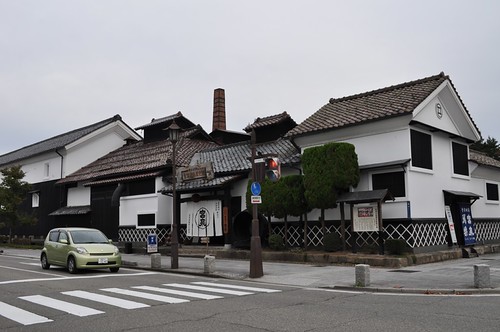
After exploring the castle and it’s grounds, we walked a little way to a Sake Brewery. Inside the Brewery was a museum which explained how sake is made. There was also free samples, but it wasn’t even lunch time yet, so we only had a cup~ We then caught the bus to a traditional shopping area, which is said to be in the ‘Taisho Romantic Style’. There were lots of traditional buildings and warehouses which contained shops selling all kinds of goods, from pottery and lacquerware, to candles and red cows (all things of which Aizu is famous for). All in all, it was very atmospheric, and my favourite part of town.

The Sake Brewery

And finally, after 3 days of travelling, we caught the Shinkansen back to Tokyo, and back to normal.

Photos can be found on flickr, as always~


Yukimidaifuku

15 11 2010

This is Yukimidaifuku

Basically ice cream wrapped in a thin layer of sweet mochi (white rice pounded to make a gelatinous paste)

This is Yukimidaifuku Torokeru Nama Caramel

The current seasonal flavour of Yukimidaifuku has caramel flavouring in the mochi, and a runny caramel centre!

The only words I have to express the awesome-ness of Yukimidaifuku is ‘Om nom nom’…


Hike – Mt Hiwada 日和田山

22 10 2010

Quick Overview

Spider Lilies

Spider Lilies

The trail to Mt Hiwada 日和田山 is very versatile, and can be used as a starting point to hike further into Chichibu 秩父, or as an easy walk back to Hanno Station 飯能駅 as described here.  If you are able to do the hike in late September, Kinchakuda 巾着田 has spectacular Spider Lilies before you head towards Koma Pass 高麗峠.  With plenty of shops and bathrooms in the area, and only a 300m high peak, this hike is perfect for families, or people wanting to have a stroll through nature.

Distance: 11km
Duration:  3 and a half hours
Difficulty: easy (very very!)
Season:  Suitable all year, maybe a little snow in winter months
Starting point:  Koma Station 高麗駅
Finishing point:  Hanno Station 飯能駅

Maps

A full map of the hike  can also be viewed at GPSies

There are a lot of different and interesting hikes in the Chichibu 秩父 area, so I recommend you buy a map, particularly if you are just using Mt Hiwada 日和田山 as a starting point.  The Mapple 山と高原地図 series number 22 map is of the Oku-Musahino 奥武蔵 and Chichibu 秩父 region, and is available on Amazon.co.jp.  Note, this map is in Japanese, but does include some English and furigana.

The Hike

Trail Marker for Mt Hiwada

Trail Marker for Mt Hiwada

From Koma Station 高麗駅 exit, turn right and follow the road under the train lines to the intersection.  Cross the road and keep going in approximately the same direction from the station down a small residential street. You will cross another road before the street turns to the left.  Keep following this road until you reach a main road, and turn right.  Cross the river and take the street up to the left at the next set of traffic lights.  If you need to pick up some supplies there is a 7-11 a little further down the main road.

Follow the road up to the left until you see the trail marker for Mt Hiwada 日和田山 (the 3rd street on the left).  Head up this street and where the street curves to the right you’ll see the trail heads for Mt Hiwada 日和田山.  There is also a rest area and bath rooms here.  It should only take about 15 minutes to reach this point.

While there are a few different trails you can start on, the main trail is on the right, and its the widest and most well-defined path.  Follow the trail up for about 10 minutes until you reach a stone Torii gate.  Here the path splits into two trails,  with the trail on the left being rocky and difficult (take caution if you use this trail), and the trail on the right being easy.

Continue up on the easy path for about 15 minutes and you will reach Kotahira Shrine 金刀比羅神社.  The Shrine is a good view-point, from which you can see views of Oku Chichibu 奥秩父, Oku Tama 奥多摩, and even Mt Fuji 富士山 on a good day.  To reach the summit, follow the trail on the right of the shrine, it should only take about 5 minutes to reach the top.

Looking at the view from Kotahira Shrine

From the summit you can continue on towards Mt Takasasu 高指山, Mt Monomi 物見山 and Musashi Yokote Station 武蔵横手駅, if you want to do more hiking in the mountains. Although in Japanese, this Seibu Website has more information about the hike to Mt Takasasu 高指山, and a map.  Otherwise, retrace your steps back down Mt Hiwada 日和田山 to the main road.  It should only take about 30 minutes to return.  

Once you reach the road, take the first road to the left (before crossing the bridge) and follow the river around to reach Kinchakuda 巾着田, a flower garden within a circular part of Koma River 高麗川.  During late September and early October the Spider Lilies should be in bloom, and there will be plenty of people about.

Aiai Bridge

Aiai Bridge

Entrance to Kinchakuda 巾着田 is 200 yen, and it will take about 40 minutes to walk from the entrance to the wooden Aiai Bridge あいあい橋 on the other side of the circle and then back to the concrete Do-Re-Me-Fa Bridge ドレミファ橋 in the middle of the circle.  Once you have strolled amongst the flowers, cross the Do-Re-Me-Fa Bridge ドレミファ橋 to exit Kinchakuda 巾着田 and start on the trail to Koma Pass 高麗峠 and Hanno station 飯能駅.

Follow the path up to the left until you reach a road.  Here there’s a marker pointing out the Musashino Nature Walking trail 武蔵野自然遊歩道 to Koma Pass 高麗峠.  Turn right, and the road will soon become trail again.  It should only take about 20 minutes to reach Koma Pass 高麗峠, where the trail splits.  If you head to the left the trail will take you round past Miyazawa Lake 宮沢湖 before going back to the Nakayama Nishi 中山西 Intersection, while the trail to the right heads straight to the same intersection.  It will only take about 20 minutes to come to the road if you use the direct trail.

Do-Re-Mi-Fa Bridge

Do-Re-Mi-Fa Bridge

One you leave the forest, cross the road at the Nakayama Nishi 中山西 intersection, and follow the road straight ahead.  As it curves to the left, there is another trail on the right, up a hill there towards Mt Tenran 天覧山 and Nonin Temple 能仁寺.  If you want to skip the temple keep to the road, and turn left at the second traffic lights.  Just follow the road sign pointing to Higashi Hanno Station 飯能駅.  Three traffic lights later turn right to go to Hanno Station 飯能駅 (again, there is a road sign pointing the way to the station).  At the end of the road you’ll come to Hanno Station 飯能駅.  It should take about 30 minutes from the turn off to Mt Tenran 天覧山 and Nonin Temple 能仁寺.

To and From

As always, the following routes are just recommendations.  Please use Hyperdia or Jorudan’s Train Route Finder to find the most suitable route for you!

From Seibu Ikebukuro Station 西武池袋駅 take the Seibu Ikebukuro line 西武池袋線 Rapid Express 快急 or Express 急行 bound for either Hanno 飯能 or Seibu Chichibu 西武秩父, if you catch a train bound for Hanno 飯能, you will need to transfer to a local train bound for Seibu Chichibu 西武秩父 at Hanno 飯能.  Get off the train at Koma Station 高麗駅, which is approximately 60 minutes and 510 yen from Ikebukuro 池袋.  The Seibu line also runs a Limited Express 特急 which will take you to Hanno station 飯能駅 in approximately 50 minutes, for an extra 410 yen.  If you catch the catch the Limited Express 特急 remember to change to a local train bound for Seibu Chichibu 西武秩父 at Hanno Station 飯能駅.

The return fare from Hanno Station 飯能駅 to Ikebukuro 池袋 is 450 yen, and takes 50 minutes on the Express 急行.

Links

Kinchakuda (Japanese) http://www.kinchakuda.com/

An alternate course to Musashi Yokote Station (in Japanese) http://www.hikingmap.jp/course/hiwadasan01.html and map http://www.hikingmap.jp/pdf/course_hiw.pdf

My Flickr photo set from Mt Hiwada http://www.flickr.com/photos/michelelisa/sets/72157624974213737/with/5053114941/

Map of hike on GPSies http://www.gpsies.com/map.do?fileId=huvzccgduxzseifd

Useful Kanji

Aiai Bridge あいあい橋
Chichibu 秩父
Do-Re-Me-Fa Bridge ドレミファ橋
Express 急行
Hanno Station 飯能駅
Kinchakuda 巾着田
Koma Pass 高麗峠
Koma River 高麗川
Koma Station 高麗駅
Kotahira Shrine 金刀比羅神社
Ikebukuro 池袋
Miyazawa Lake 宮沢湖
Mt Fuji 富士山
Mt Hiwada 日和田山
Mt Monomi 物見山
Mt Takasasu 高指山
Mt Tenran 天覧山
Musashino Shizen Walking trail 武蔵野自然遊歩道
Musashi Yokote Station 武蔵横手駅
Nakayama Nishi 中山西
Nonin Temple 能仁寺
Oku Chichibu 奥秩父
Oku-Musahino 奥武蔵
Oku Tama 奥多摩
Rapid Express 快急
Seibu Ikebukuro line 西武池袋線
Seibu Ikebukuro Station 西武池袋駅
Seibu Chichibu 西武秩父
Limited Express 特急


good ‘cherry’ hunting

5 07 2010

Sorry I haven’t updated in a while!  It’s been busy to say the least!  So much as been happening lately, between parties, meeting old friends, work, and the Japanese Language Proficiency Test (yesterday), I haven’t had much time for myself lately.  But I did manage to take some time out a few weeks ago to go on a Hato Bus tour “Hunting for cherries”.

One of the things I love (and hate) about Japan is the difference in the seasons.  And one thing that changes with the seasons is the fruit that is available.  For example, in winter I live on mikan.  But in June, my absolute favourite fruit becomes available – the Japanese Cherry.  There are a few varieties of Japanese Cherries, and, in general, they are pinker and lighter in color than most cherries available in Australia, and are also much sweeter, although there are some slightly sour varieties.

A couple of prefectures in Japan are famous for their cherries, namely Yamagata and Yamanashi.  Having tasted both, I highly recommend Yamagata cherries, but at about 600 or 700 yen for 200g, they are quite expensive.  Another option to get your fill is to go to a farm that offers an ‘all you can eat, pick them yourself’ deal.  Usually you are able to walk around an orchard for about 30 or 40 minutes, and pick (or ‘hunt for’) as many cherries as you like to eat right there for about 1000 to 2000 yen.  And trust me, you can eat a lot in that time…  However, if you want to take some home you have to buy them separately.

As I don’t have a car, the easiest way for me to do this was to go on a tour.  My friend and I went on a Hato bus tour, that not only included cherry picking, but also a visit to Mt Fuji, a buffet lunch, and a brief stop at a Japanese sweets factory called Kikyoya.  The cost was about 9,500 yen, but it really was worth it as it was a full day – almost 13 hours!

We were really lucky with Mt Fuji, because despite being June and cloudy we were able to see the whole mountain.  Actually, when I booked the tour, I didn’t check what the extra activities apart from lunch and cherry picking were, so I wasn’t prepared for this stop.  The 5th station is about 2300m above sea level so it’s much cooler.  On that day it was 10 deg C and raining, and even though I had bought an umbrella, I neglected to bring a jacket.

After that it was on to lunch at the Fuji View Hotel.  It’s owned by a fairly famous hotel chain, and actually had John Lennon stay there once, but their lunch buffet was pretty standard.  There was one thing on the menu that is a Yamanashi original dish – Houtou.  Basically a miso soup with flat udon noodles and a pumpkin flavor.  It was really yummy, and I’m looking forward to trying to make it myself once it gets cooler again.

Next it was off to the Japanese sweets factory, where we were taught how to wrap Shingen-mochi.  Kikyoya is also the home of a very impressive display of sugar flowers, animals and trees.  There were so many different displays that I’ll be doing a separate photo!spam post later this week.  But here’s a sneak peek…

And lastly, the cherry picking.  Normally I’m actually quite nervous climbing up ladders, but apparently when there are cherries at the top I have no problems.  On top of stuffing my self stupid at the cherry orchard, I also bought about a kilo of cherries to make sakuranbou-shu (expect a video of that adventure in about 6 months once it’s finished…  stewing?).

And of course, what’s being a tourist without some shopping!

As always more photos are on flickr, and a post about the sweets with also appear later this week!


Brisbane Bites

28 05 2010

Okay, so, I know I’m going to get into trouble for this…  But during golden week I snuck back to Australia for my grandfather’s 90th birthday.  As I didn’t have much time, I only told a couple of friends, so I’m sorry if I missed catching up with anyone who wanted to.  Trust me, my trip was far too short.

Going back to Australia means a few things for me, but eating some of my favourite foods is up there on my to do list.  So here’s what I ate in Australia!

Firstly, the reason for the visit – my grandfather’s birthday cake.  (no, wait…  that’s not quite right….)  The cake is a fruitcake with fondue icing.  We had a friend make it, and she did a brilliant job with our instructions of a ‘cricket theme’.  The bat, stumps, ball, and pads were all made by hand.  She even rolled out liquorice to make the grip on the bat!  And most importantly, it was delish!

We also went down to the Beerwah Pub for lunch, where I had a vegetarian lasagna, and stole some oysters Kilpatrick from my cousin.

Actually, most of my time was spent at Beerwah, where I was spoilt by my mother with a Roast Chicken dinner, and fresh scones.  But during the little time I spent in Brisbane I was taken out to dinner twice by friends.  Firstly was burgers at Grill’d, which live up to their reputation.  Although I had a bacon and cheese burger this time, my all time favourite is the Big Queenslander, because all real burgers should have a slice of beetroot.

The other dinner excursion was to the Satay Hut, a Malaysian restaurant, at Southbank.  We had a set for 2 people which included satay sticks, spring rolls, a curry, garlic vegetables, spicy fried seafood , and all you can eat rice.  It was super tasty, but far too much for us, and we had to ask for a doggy bag.  We also stopped at My Sweetopia to buy some cupcakes to eat later.

That weekend was Buddha’s Birthday, so we saw some of the celebrations at Southbank.  And I took some funky photos 🙂

I also had fun with my iPhone driving through Brissy, and you can see some fuzzy (intentionally) shots in my new iPhone folder on flickr.

And apart from seeing my family, and a little shopping, that was my trip to BrisVegas!