Shinjuku Gyoen Kiku and Roses 新宿御苑 菊とバラ

28 01 2011

Ogiku Chrysanthemums

Ogiku Chrysanthemums

Kiku 菊 (Chrysanthemum) are another symbol of Japan, particularly the Imperial Family, and the Imperial Family’s Chrysanthemum crest can found all over Japan on buildings, and even on the Japanese passport. Fittingly, the Imperial Family Household holds a Kiku Exhibition in Shinjuku Gyoen from November 1st to 15th.

The exhibition not only gives you a chance to see some beautiful and unusual varieties of Kiku and traditional ways to display them, but also coincides with autumn roses (‘bara’ バラ in Japanese) flowering in the French garden, and the start of leaves turning to their autumn colours all over the park. Entrance to the park is 200 yen, and it can be accessed from Shinjuku-gyoenmae Station (1-2 minute walk), Shinjuku-sanchome Station (3-5 minute walk), Shinjuku Station South Exit (10 minute walk), Sendagaya Station (5 minute walk), and Kokuritsu-kyogijo Station (5 minute walk).

Here are a few photos I took on November 13th.

A traditional Ozukuri bed of Kiku

A traditional Ozukuri bed of Kiku

Edo Variety of Kiku, which changes in appearance as it opens

Edo Variety of Kiku, which changes in appearance as it opens

Ichimonji variety of Kiku, from which the Imperial Family crest is inspired

Ichimonji variety of Kiku, from which the Imperial Family crest is inspired

Fallen autumn leaves

Fallen autumn leaves

Cream Delight Rose

Cream Delight Rose

More photos can be seen in my flickr set.


Cosmos コスモス

12 11 2010

Pink Cosmos

Pink Cosmos

Cosmos コスモス are another flower that can be seen here and there in Japan, but also en masse in specially planted fields. They can bloom as early as late September, but usually peak around mid October, and last until the end of the month.

There are many places with special Cosmos fields, so you can probably find something close to where you are.

This year I went to Washinomiya 鷲宮, in Saitmama 埼玉県, which is on the Tobu Isezaki Line 東部伊勢崎線, or also accessible from Higashi Washinomiya 東鷲宮 on the JR Utsunomiya line 宇都宮線. Washinomiya’s Cosmos Fureai Road コスモスふれあいロード follows a river for 12km, and is lined by over 8 million plants, so it’s makes quite a lovely Sunday afternoon stroll. They also hold a festival during the peak season (usually a weekend mid October) at the Washinomiya Town Office 鷲宮市役場.

All the pretty colours

All the pretty colours

Along the Cosmos Fureai Road

Along the Cosmos Fureai Road

Red Cosmos Flower

Red Cosmos Flower

To view my photos in larger sizes, please check out my Flickr set!


Hike – Mt Hiwada 日和田山

22 10 2010

Quick Overview

Spider Lilies

Spider Lilies

The trail to Mt Hiwada 日和田山 is very versatile, and can be used as a starting point to hike further into Chichibu 秩父, or as an easy walk back to Hanno Station 飯能駅 as described here.  If you are able to do the hike in late September, Kinchakuda 巾着田 has spectacular Spider Lilies before you head towards Koma Pass 高麗峠.  With plenty of shops and bathrooms in the area, and only a 300m high peak, this hike is perfect for families, or people wanting to have a stroll through nature.

Distance: 11km
Duration:  3 and a half hours
Difficulty: easy (very very!)
Season:  Suitable all year, maybe a little snow in winter months
Starting point:  Koma Station 高麗駅
Finishing point:  Hanno Station 飯能駅

Maps

A full map of the hike  can also be viewed at GPSies

There are a lot of different and interesting hikes in the Chichibu 秩父 area, so I recommend you buy a map, particularly if you are just using Mt Hiwada 日和田山 as a starting point.  The Mapple 山と高原地図 series number 22 map is of the Oku-Musahino 奥武蔵 and Chichibu 秩父 region, and is available on Amazon.co.jp.  Note, this map is in Japanese, but does include some English and furigana.

The Hike

Trail Marker for Mt Hiwada

Trail Marker for Mt Hiwada

From Koma Station 高麗駅 exit, turn right and follow the road under the train lines to the intersection.  Cross the road and keep going in approximately the same direction from the station down a small residential street. You will cross another road before the street turns to the left.  Keep following this road until you reach a main road, and turn right.  Cross the river and take the street up to the left at the next set of traffic lights.  If you need to pick up some supplies there is a 7-11 a little further down the main road.

Follow the road up to the left until you see the trail marker for Mt Hiwada 日和田山 (the 3rd street on the left).  Head up this street and where the street curves to the right you’ll see the trail heads for Mt Hiwada 日和田山.  There is also a rest area and bath rooms here.  It should only take about 15 minutes to reach this point.

While there are a few different trails you can start on, the main trail is on the right, and its the widest and most well-defined path.  Follow the trail up for about 10 minutes until you reach a stone Torii gate.  Here the path splits into two trails,  with the trail on the left being rocky and difficult (take caution if you use this trail), and the trail on the right being easy.

Continue up on the easy path for about 15 minutes and you will reach Kotahira Shrine 金刀比羅神社.  The Shrine is a good view-point, from which you can see views of Oku Chichibu 奥秩父, Oku Tama 奥多摩, and even Mt Fuji 富士山 on a good day.  To reach the summit, follow the trail on the right of the shrine, it should only take about 5 minutes to reach the top.

Looking at the view from Kotahira Shrine

From the summit you can continue on towards Mt Takasasu 高指山, Mt Monomi 物見山 and Musashi Yokote Station 武蔵横手駅, if you want to do more hiking in the mountains. Although in Japanese, this Seibu Website has more information about the hike to Mt Takasasu 高指山, and a map.  Otherwise, retrace your steps back down Mt Hiwada 日和田山 to the main road.  It should only take about 30 minutes to return.  

Once you reach the road, take the first road to the left (before crossing the bridge) and follow the river around to reach Kinchakuda 巾着田, a flower garden within a circular part of Koma River 高麗川.  During late September and early October the Spider Lilies should be in bloom, and there will be plenty of people about.

Aiai Bridge

Aiai Bridge

Entrance to Kinchakuda 巾着田 is 200 yen, and it will take about 40 minutes to walk from the entrance to the wooden Aiai Bridge あいあい橋 on the other side of the circle and then back to the concrete Do-Re-Me-Fa Bridge ドレミファ橋 in the middle of the circle.  Once you have strolled amongst the flowers, cross the Do-Re-Me-Fa Bridge ドレミファ橋 to exit Kinchakuda 巾着田 and start on the trail to Koma Pass 高麗峠 and Hanno station 飯能駅.

Follow the path up to the left until you reach a road.  Here there’s a marker pointing out the Musashino Nature Walking trail 武蔵野自然遊歩道 to Koma Pass 高麗峠.  Turn right, and the road will soon become trail again.  It should only take about 20 minutes to reach Koma Pass 高麗峠, where the trail splits.  If you head to the left the trail will take you round past Miyazawa Lake 宮沢湖 before going back to the Nakayama Nishi 中山西 Intersection, while the trail to the right heads straight to the same intersection.  It will only take about 20 minutes to come to the road if you use the direct trail.

Do-Re-Mi-Fa Bridge

Do-Re-Mi-Fa Bridge

One you leave the forest, cross the road at the Nakayama Nishi 中山西 intersection, and follow the road straight ahead.  As it curves to the left, there is another trail on the right, up a hill there towards Mt Tenran 天覧山 and Nonin Temple 能仁寺.  If you want to skip the temple keep to the road, and turn left at the second traffic lights.  Just follow the road sign pointing to Higashi Hanno Station 飯能駅.  Three traffic lights later turn right to go to Hanno Station 飯能駅 (again, there is a road sign pointing the way to the station).  At the end of the road you’ll come to Hanno Station 飯能駅.  It should take about 30 minutes from the turn off to Mt Tenran 天覧山 and Nonin Temple 能仁寺.

To and From

As always, the following routes are just recommendations.  Please use Hyperdia or Jorudan’s Train Route Finder to find the most suitable route for you!

From Seibu Ikebukuro Station 西武池袋駅 take the Seibu Ikebukuro line 西武池袋線 Rapid Express 快急 or Express 急行 bound for either Hanno 飯能 or Seibu Chichibu 西武秩父, if you catch a train bound for Hanno 飯能, you will need to transfer to a local train bound for Seibu Chichibu 西武秩父 at Hanno 飯能.  Get off the train at Koma Station 高麗駅, which is approximately 60 minutes and 510 yen from Ikebukuro 池袋.  The Seibu line also runs a Limited Express 特急 which will take you to Hanno station 飯能駅 in approximately 50 minutes, for an extra 410 yen.  If you catch the catch the Limited Express 特急 remember to change to a local train bound for Seibu Chichibu 西武秩父 at Hanno Station 飯能駅.

The return fare from Hanno Station 飯能駅 to Ikebukuro 池袋 is 450 yen, and takes 50 minutes on the Express 急行.

Links

Kinchakuda (Japanese) http://www.kinchakuda.com/

An alternate course to Musashi Yokote Station (in Japanese) http://www.hikingmap.jp/course/hiwadasan01.html and map http://www.hikingmap.jp/pdf/course_hiw.pdf

My Flickr photo set from Mt Hiwada http://www.flickr.com/photos/michelelisa/sets/72157624974213737/with/5053114941/

Map of hike on GPSies http://www.gpsies.com/map.do?fileId=huvzccgduxzseifd

Useful Kanji

Aiai Bridge あいあい橋
Chichibu 秩父
Do-Re-Me-Fa Bridge ドレミファ橋
Express 急行
Hanno Station 飯能駅
Kinchakuda 巾着田
Koma Pass 高麗峠
Koma River 高麗川
Koma Station 高麗駅
Kotahira Shrine 金刀比羅神社
Ikebukuro 池袋
Miyazawa Lake 宮沢湖
Mt Fuji 富士山
Mt Hiwada 日和田山
Mt Monomi 物見山
Mt Takasasu 高指山
Mt Tenran 天覧山
Musashino Shizen Walking trail 武蔵野自然遊歩道
Musashi Yokote Station 武蔵横手駅
Nakayama Nishi 中山西
Nonin Temple 能仁寺
Oku Chichibu 奥秩父
Oku-Musahino 奥武蔵
Oku Tama 奥多摩
Rapid Express 快急
Seibu Ikebukuro line 西武池袋線
Seibu Ikebukuro Station 西武池袋駅
Seibu Chichibu 西武秩父
Limited Express 特急


Kinchakuda Manjushage 巾着田の曼珠沙華

9 10 2010
Manjushage

Manjushage

Manjushage 曼珠沙華, or Spider Lilies, bloom in late September to early October. They can be spotted in small numbers in gardens and green areas around Tokyo, and are quite beautiful, but are spectacular en masse.

Kinchakuda 巾着田 is about one hour out from Ikebukuro on the Seibu Ikebukuro line and the Seibu Chichibu line, and is accessible from Koma Station 高麗駅. It is a flower field on the inside of a river that almost curves around 360 degrees, and has over a million blooms in red and a few in white. It also has a small field of Cosmos コスモス that bloom around the same time, and a number of hikes and walks in the area.  Entrance to the park is 200yen.  More details about Kinchakuda 巾着田 can be found on the official website (Japanese only).

A guide to hiking the nearby Mt Hiwata and Koma Pass is also coming soon.

Here are a few photos from my visit to the field on October 2nd 2010.

White Manjushage

White Manjushage

Kinchakuda

Kinchakuda

Manjushage and Koma River

Manjushage and Koma River

Red Manjushage

Red Manjushage

For more photos of Manjushage check out my set at Flickr!


Hike – Mt Nyukasa (Fujimi Panorama) 入笠山 (富士見パノラマ)

22 09 2010

Quick Overview

Nyukasa Marsh

Nyukasa Marsh

Although a bit of a trek from Tokyo 東京, Fujimi Panorama 富士見パノラマ and Mt Nyukasa 入笠山 is a great trip for flower lovers during spring, in particular it is famous for its Lily of the Valley, or Suzuran すずらん.  During winter it becomes a ski resort, but it is still possible to climb to the summit of Mt Nyukasa 入笠山 to see the 360 degree panorama, which includes views of Mt Fuji 富士山, Yatsugatake 八ヶ岳, and the Japanese Northern, Central and Southern Alps 北, 中央, 南アルプス.  The climb is really easy, with only 30 minutes up hill to the highest peak, and the rest of the trail is fairly flat with forests and marshlands.

Duration:  3 hours, 15 minutes
Difficulty: easy
Season:  Suitable all year (becomes a ski slope in winter, with snowshoeing to the summit)
Starting point:  Fujimi Panorama Resort 富士見パノラマリゾート
Finishing point:  Fujimi Panorama Resort 富士見パノラマリゾート

Maps

This map of the hike  can also be viewed at GPSies

The Hike

From Fujimi Station 富士見駅, take the exit and in the small car park there should be signs for the Fujimi Panorama Free Shuttle Bus 富士見パノラマ無料送迎バス.  Just catch the bus to the lower Fujimi Panorama 富士見パノラマ carpark, about 10 minutes, buy your return gondola ticket (1,600 yen) and then walk up between the shops and then right along the bottom of the ski slopes to reach the gondola station.

Nyukasa Suzuran Garden

Nyukasa Suzuran Garden

The gondola will take you up a fair way, and when you reach the top (Sancho Station ゴンドラ山頂駅) just follow the signs to the right towards the Nyukasa Suzuran garden 入笠すずらん公園.  The garden itself isn’t very large, but it contains a number of different varieties of wild flowers.  The season for Lilly of the Valley (Suzuran すずらん) is throughout June , but there are other flowers blooming all through spring and into summer.Once you are finished in the Nyukasa Suzuran garden 入笠すずらん公園, head up hill, but before starting to climb up the stairs, take the path to the right around the hill.  Be careful to take the correct path, as there are actually two, one for walkers, and the other for mountain bikers who will race past, but don’t worry, its pretty obvious which is which.

Follow the path around the hill for about 10 minutes, before crossing a road, and entering a gated area.  This is the start of Nyukasa Marsh 入笠湿原.  Within the marsh make sure to keep to the board walks, but despite them, it’s still a very pretty area, also with a number of different flowers like irises.

Nyukasa Marsh

Nyukasa Marsh

When you are finished there, take the exit on the opposite side to where you entered.  There will be a mountain hut here where you can buy lunch and the only bathroom on the track.  Continuing on, take the road to the left, and shortly there will be a path on the left through a forested area.  Follow this path for about 10 minutes.

Once you leave the forested area, you will be able to see Mt Nyukasa 入笠山 directly ahead.  Half of the mountain is grassland again.  Keep following the path until you reach another road, and follow that up.  You will come to another building that has an observatory, but keep heading up hill to the left of it.  From this point it will take about 30 minutes to the summit of Mt Nyukasa 入笠山, with only one alternative trail headed left.  Just keep to the right and shortly before the summit the trees will give way to the barren peak.

Mt Nyukasa Panorama

Mt Nyukasa Panorama

From Mt Nyukasa 入笠山 there is a 360 degree view.  On a clear day you can see Yatsugatake 八ヶ岳, the Japanese Northern, Central and Southern Alps 北, 中央, 南アルプス, and even Mt Fuji 富士山.  When you are ready to continue, head down the path opposite to the one you climbed up on.  Walking down hill will mainly be through a bamboo area, and after 15 minutes you should reach the road.  Head right, and about 5 minutes later you will see Kubikiri spring 首切清水 on the right.

Kubikiri Spring

Kubikiri Spring

Kibukiri 首切 actually means decapitation, and this spring was named that because couriers travelling to and from the gold mines in the area in past days would stop for a drink and have their heads cut off by bandits.  Nowadays the water isn’t safe to drink, not because of bandits, but because cattle is grazed in the area.

Keep heading on the road and after about 20 minutes you’ll reach Oahara Marsh 大阿原湿原.  Again, stick to the board walks here.  Unfortunately you can only walk around the marsh, but it’s still very scenic, especially during the fall season.  To walk around the marsh only takes about 40 minutes, and will return you to the road you were on previously.  Now just follow the road back to the Nyukasa marsh 入笠湿原, taking approximately 50 minutes.

Oahara Marsh

Oahara Marsh

From here, just backtrack through the wooded area around the hill for 15 minutes to return to Gondola Sancho Station ゴンドラ山頂駅.

To and From

As always, the following routes are just recommendations.  Please use Hyperdia or Jorudan’s Train Route Finder to find the most suitable route for you!

From Shinjuku Station 新宿駅 you can either catch the Azusa あずさ or the Chuo Line 中央線, headed towards Nagano 長野 and Tachikawa 立川 respectively.  The Azusa あずさ does the trip to Fujimi Station 富士見駅 in about 140 minutes, Unreserved seats are 5,360 yen, or Reserved seats are 5,870 yen.  The Chuo line 中央線 takes approximately 230 minutes and costs 3,260 yen.  On the Chuo line you will probably have to change trains 3 times to reach Fujimi Station 富士見駅, at Tachikawa 立川, Hachioji 八王子 and Kofu 甲府.

Unfortunately Fujimi 富士見 is outside of the area included in the JR Holiday pass.

On weekends and public holidays from the end of April to the start of November, and during the ski season, the Fujimi Panorama Resort 富士見パノラマレゾート runs a free shuttle bus from Fujimi Station 富士見駅 to the lower Suzuran Gondola station すずらんゴンドラ駅.

From the lower gondola station, ride it up to Gondola Sancho Station ゴンドラ山頂駅.  A return ticket on the gondola costs 1,600 yen.  The gondola starts running at 9:30am, and stops at 4:30pm.

Links

Fujimi Panorama Resort (Japanese) http://www.fujimipanorama.com/summer/index.php

Fujimi Kougen Tourist Information (Japanese) http://www.fujimikougen.info/

Hiking course map (Japanese) http://www.fujimikougen.info/hiking/img/02.pdf

Map of hike on GPSies http://www.gpsies.com/map.do?fileId=rqkqvzhbbypoklzm

My Flickr photo set from Mt Nyukasa http://www.flickr.com/photos/michelelisa/sets/72157624475871102/

Useful Kanji

Azusa あずさ
Chuo Line 中央線
Central Alps 中央アルプス
Fujimi 富士見
Fujimi Panorama 富士見パノラマ
Fujimi Panorama Resort 富士見パノラマリゾート
Fujimi Panorama Free Shuttle Bus 富士見パノラマ無料送迎バス
Fujimi Station 富士見駅
Gondola Sancho Station ゴンドラ山頂駅
Hachioji 八王子
Kibukiri 首切
Kubikiri spring 首切清水
Kofu 甲府
Lily of the Valley (Suzuran) すずらん
Mt Fuji 富士山
Mt Nyukasa 入笠山
Nagano 長野
Northern Alps 北アルプス
Nyukasa Marsh入笠湿原
Nyukasa Suzuran garden 入笠すずらん公園
Oahara Marsh 大阿原湿原
Shinjuku Station 新宿駅
Southern Alps 南アルプス
Suzuran Gondola station すずらんゴンドラ駅
Tachikawa 立川
Tokyo 東京
Yatsugatake 八ヶ岳


Shibazakura 芝桜

11 09 2010
Shibazakura

Shibazakura

A literal translation of Shibazakura is ‘lawn cherry blossom’, and although it isn’t actually cherry blossom (in fact, Shibazakura is known as Pink Moss, or Mountain Phlox, in english) it certainly creates a beautiful carpet of whites, pinks and blues, that lives up to the beauty of cherry blossoms.

In Japan, Shibazakura tends to bloom just in time for Golden Week, the first week of May, but only peaks for about a week in low lying areas.  Higher altitudes can extend the time of the ‘carpet’ effect a little longer.

Shibazakura

Shibazakura

Nearby Tokyo there are three areas that are particularly famous for Shibazakura – Chichibu, Kawaguchi-ko , and Tatebayashi.  Each of these places has their own particular charm.  Chichibu’s Hitsujiyama boasts over 400,000 plants, in 9 different varieties.  The Fuji Shibazakura Festival site near Kawaguchi-ko has beautiful views of Mt Fuji.  And the Yachonomori Gardens in Tatebayashi has a variety of different gardens with a huge number of various trees and plants.  Tatebayashi also has the advantage of being close to the Tsutsujigaoka (Azalea Hill) park which also blooms around Golden Week, and a Children’s Day festival held during the same week with large carp streamers lining a river nearby.

Although I didn’t have the opportunity to visit any of these places during Golden Week, I managed to visit Tatebayashi Yachonomori Gardens a few weeks later.  The Gardens are a short 20 minute walk from Morinjimae Station on the Tobu Isezaki Line (bound for Tatebayashi).

Unfortunately I was too late for the carpets of pink flowers –

Pink Moss carpets

Pink Moss carpets

But the light pink flowers were still looking good –

Light Pink blossoms

Light Pink blossoms

And other flowers were in bloom –

Wisteria

Wisteria

Lupins

Lupins

Poppies

Poppies

Baby Blue Eyes

Baby Blue Eyes

So, even if you miss the peak of the Shibazakura, Yachonomori still has something for flower lovers.

You can check out more of my photos on Flickr!


Yozakura 夜桜

14 08 2010
Sakura and Paper Lantern

Sakura and Paper Lantern

Sakura 桜 (Cherry Blossom) are beautiful no matter what time of day you view them, but there are a number of places in and around Tokyo that also have night ‘Illuminations’ of the blossoms.

There is even a special word for cherry blossoms in the evening – Yozakura 夜桜 (literally ‘night cherry blossoms’).  The illuminations range from the whole trees being spotlighted, to the more traditional, with lanterns hanging amongst the branches.

Toshimaen, Tokyo

Toshimaen Sakura Illumination

Toshimaen Sakura Illumination

Toshimaen is an ‘old school’ amusement park in Nerima with whole tree spotlights.  Normally there is an entrance fee to the park, but during the Sakura season, entrance from about 4pm becomes free for the night-time illumination.  In fact, inside and out of the park are a lot of Sakura trees, and the area is quite beautiful in spring (but then, I might be bias, I used to live there).

Kita Koshigaya

Lanterns and path

Lanterns and path

Sakura at Dusk

Sakura at Dusk

These photos are taken at Kita Koshigaya, a place I mentioned in my last Sakura post, from dusk to darkness.  Kita Koshigaya’s Illumination is more of the traditional kind, with paper lanterns.  You might notice on each lantern something different is written, these are the names of the people or the company that ‘sponsors’ the lantern.  It’s quite pretty, but also very hard to photo (especially on a windy evening)!

Blossoms in the dark

Blossoms in the dark

To see these photos in full, or see a few more not shown here, please check out my flickr set! Enjoy the flowers!


sugary, flowery, photo!spam

13 07 2010

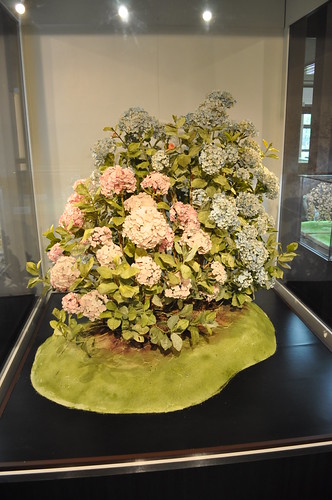
As I mentioned in my ‘good ‘cherry’ hunting’ post, the Japanese sweet factory Kikyoya that we visited has a very impressive museum of sugar flowers.  Now, to be honest, I’m not sure if these were all made by hand, or if they are all made of sugar, but I’m positive they would have to have been put together by hand and would have taken a long time to make.

So, firstly we have some purple and white flowers –

and a close up –

isn’t the detail amazing?

Irises –

Bamboo shoots –

Gourds –

A hydrangea bush –

and a close up of the hydrangeas –

Imagine sticking all those flowers together!!!

And lastly, probably my favourite, autumn leaves –

although this next close up isn’t from the tree above, it’s kinda similar, being an omikuji (fortune) tied to a branch of autumn leaves –

Of course this is only a few of the photos I’ve taken, so if you’d like to see more please head on over to my flickr set!  It includes fish, cosmos, lilies, snow covered grass, wisteria, cherry blossoms and more!


Hike – Mt Hinokiboramaru (Tanzawa) 檜洞丸 (丹沢)

20 06 2010

Quick Overview

Hinokiboramaru

Hinokiboramaru

A well signed (albeit mainly in Japanese) hike through the Tanzawa 丹沢 mountain range. Quite steep and slippery in places, and also quite long, this hike is worth it for the beautiful azaleas near the peak of Hinokiboramaru 檜洞丸 (mid-May to June), waterfalls and beech tree forests.  Just make sure you start early in the day to make the last bus, or there are many places to camp and mountain huts nearby, so staying overnight and doing more exploring in the area is an option.  During the winter and spring there are also views of Mt Fuji 富士山.

Distance: 11km
Duration:  7 to 8 hours
Difficulty: medium (slippery and steep in places, also quite long)
Season:  Suitable all year, maybe a little snow in winter months
Starting point:  Nishi Tanzawa Shizen Kyoshitsu Bus Stop 西丹沢自然教室バス停
Finishing point:  Houkizawakoenbashi Bus Stop 箒沢公園橋バス停

Maps

A full map of the hike  can also be viewed at GPSies

There are many different and interesting hikes in this area, so I recommend you buy a map.  The Mapple 山と高原地図 series number 28 map is of the Tanzawa 丹沢 region, and is available on Amazon.co.jp.  Note, this map is in Japanese, but does include some English and furigana.

The Hike

Start of the trail

Start of the trail

You’ll start this hike from the final bus stop on the line, Nishi Tanzawa Shizen Kyoshitsu Bus Stop 西丹沢自然教室バス停.  At the bus stop there is the Nishi Tanzawa Shizen Kyoshitsu 西丹沢自然教室 (Nature Classroom), where you should leave your name, contact details and blood type, for emergencies whist on the trail.  They also display up to date trail information, and the last bathroom before Hinokiboramaru 檜洞丸 is here.

Once you have finished at the Shizen Kyoshitsu 自然教室, continue walking up the road from the bus stop.  You will soon cross a bridge over a river, and see signs pointing to a camp site.  After about 10 minutes you will see a small creek on the right, and a sign pointing to Hinokiboramaru 檜洞丸.  Walk up the creek for 50 meters, and on your left will be some stairs.  These stairs lead to the start of the trail.  The first 20 minutes or so will be uphill, but after that the trail will level out until you reach Gorazawadeai ゴーラ沢出合.  It should take 60 minutes from the trail head to Gorazawadeai ゴーラ沢出合.

Gorazawadeai

Gorazawadeai

Gorazawadeai ゴーラ沢出合 is a river crossing, but the river is small, and not deep.  It’s mostly a rocky riverbed, with some man-made waterfalls nearby.  Cross the river and follow on its right hand side until you reach some stairs.  Once again climb the stairs to return to the trail.  Shortly after Gorazawadeai ゴーラ沢出合 there is a bench if you want to stop and rest.  From Gorazawadeai ゴーラ沢出合 you have entered the ‘New Azalea Road’ つつじ新道, and the trail will become steep.

After another 60 minutes you will reach another bench and a viewpoint at Tenboenchi 展望園地.  From here it’s another hour until the next intersection, and the trail becomes steeper still.  However, you will start to see more mountain azaleas along the way.  At the intersection take the path to the left up, signed Hinokiboramaru 檜洞丸.

This section of the trail is boarded (see the picture next to ‘Quick Overview’), and is a nice easy climb that should only take 10 to 20 minutes.  It is also quite pretty, with some old gnarled and mossy trees.  Not far before the summit you will pass some solar panels on the right.

Mountain Azalea

Mountain Azalea

At the summit of Hinokiboramaru 檜洞丸 there is a marker, small stone shrine, and a couple of benches.  You can also head down the trail on the opposite side of the summit if you want to use the toilet at the mountain hut.  It’s only 5 minutes, and they ask you pay a tip of 50 yen to use the facilities (don’t forget tissues either!).  The mountain hut also sells a very small selection of food and drink, but it’s a little expensive.

To start down, return along the boarded walk to the intersection, and take the other trail marked for Hokisawa 箒沢.  There are a couple of intersections along this trail, but if you take the trail to the right each time you will be headed to Hokisawakoen 箒沢公園.

The first part of the decent is fairly easy, and goes through a nice beech tree forest.  You will pass another trail to Dougakuyama 同角山 after 10 minutes, and then shortly a bench, before climbing a little to the peak of Teshironoatama テシロノ頭.  Continuing down hill you will pass another bench before seeing a very large old moss-covered tree (see below).  Not long after this is the second alternative trail, but again keep to the right towards Hokisawa 箒沢.  It should have taken about 60 minutes to this intersection from the one before.

Beech Tree forest

Beech Tree forest

From now the trail becomes much steeper, despite climbing another couple of peaks, Yabusawanoatama ヤブ沢ノ頭 followed by Itagoyasawanoatama 板小屋沢ノ頭.  There will be sections with ropes to help you down, and some slippery sections without.

From the last intersection it should take about 90 minutes to reach another river, which you will follow on the right hand side for most of the rest of the hike.  The final 20 minutes along side the river is much easier than the last few hours, but still there are some slippery places and stairs to climb up and down.  Just keep the river on your left for about 15 minutes, until you reach a river crossing.  Cross the river, and following it until you can cross back over again.  Only a little further along the trail you will find the Oishi Camping ground 大石キャンプ場, which has a number of cabins as well.

Cross the bridge in front of the camping ground to reach the main road, turn right and the Houkizawakoenbashi Bus Stop 箒沢公園橋バス停 is only a few meters up the road.

To and From

As always, the following routes are just recommendations.  Please use Hyperdia or Jorudan’s Train Route Finder to find the most suitable route for you!

From Shinjuku Station 新宿駅 take the Odakyu Line 小田急線 express 急行 headed to Odawara and jump off at Shin Matsuda 新松田, 84 minutes and 750 yen.  A line map of the Odakyu lines 小田急線 can be found here (in English).  Take the North exit 北口, and then catch the Fujikyu bus 富士急バス from Stop 1 to Nishi Tanzawa Shizen Kyoshitsu 西丹沢自然教室, 1150 yen and 70 minutes.  A timetable of the Fujikyu Bus 富士急バス can be found here for Saturday, and here for Sunday (only Japanese).

On the return, catch the bus back to Shin Matsuda 新松田 from Houkizawakoenbashi Bus Stop 箒沢公園橋バス停, 60 minutes and 1050yen.  Then catch the express back to Shinjuku 新宿 on the Odakyu line 小田急線, 84 minutes and 750 yen.

Links

Fujikyu Bus Schedule for Saturdays http://www.fujikyu.co.jp/syonan/rosen_time/time01_s.html

Fujikyu Bus Schedule for Sunday http://www.fujikyu.co.jp/syonan/rosen_time/time01_h.html

Odakyu Rail Map http://www.odakyu.jp/english/route/railmap/index.html

My Flickr photo set from Mt Hinokiboramaru http://www.flickr.com/photos/michelelisa/sets/72157624111661525/

Photos from another member of the group I hiked with http://www.m-miyata.jp/yama/Hinokiboramaru1006.html

Map of hike on GPSies http://www.gpsies.com/map.do?fileId=kmnhlwuwyoyogyxp

Useful Kanji

Tanzawa 丹沢
Hinokiboramaru 檜洞丸
Mt Fuji 富士山
Nishi Tanzawa Shizen Kyoshitsu 西丹沢自然教室
Nishi Tanzawa Shizen Kyoshitsu Bus Stop 西丹沢自然教室バス停
Hokisawa 箒沢
Hokisawakoen 箒沢公園
Houkizawakoenbashi Bus Stop 箒沢公園橋バス停
Gorazawadeai ゴーラ沢出合
‘New Azalea Road’ つつじ新道
Tenboenchi 展望園地
Dougakuyama 同角山
Teshironoatama テシロノ頭
Yabusawanoatama ヤブ沢ノ頭
Itagoyasawanoatama 板小屋沢ノ頭
Oishi Camping ground 大石キャンプ場
Shinjuku Station 新宿駅
Odakyu Line 小田急線
Express 急行
Shin Matsuda 新松田
North exit 北口
Fujikyu bus 富士急バス


Sakura 桜

26 05 2010
Pink and White Sakura

Pink and White Sakura

Sakura 桜 (Cherry Blossom) are the iconic Japanese flower.  They bloom for a short period (about a week) around the last week of April and first week of May in Tokyo.  Although short-lived, they are prolific, and trees seem to be covered in masses of blooms which makes me think of pink snow.

No matter where you are in Japan, if you are here in Sakura season, a well-known and beautiful place to view the blossoms won’t be far away.  Although this is only a short list, these places are my pick for Sakura in Tokyo and Saitama.

Ueno Park, Tokyo

Ueno Park in bloom

Ueno Park in bloom

One of the most famous places in Tokyo for Hanami (literally flower viewing) parties.  Always busy during Sakura season, but with good reason!  More than 1000 Sakura trees line the pathways through the park, and many groups reserve their spots under the trees from early in the day.  Although I have never attended a Hanami party here, almost every season I go for a walk mid afternoon just to soak up the atmosphere.  Not a place for quite contemplation of the blossoms, but perfect if you want to get a feel for the party side of the season.

From the JR Ueno Station, take the Park exit and walk straight ahead over the road into the park.  Most of the blossoms are on the paths to the left, but all of Ueno Park is quite interesting, with shrines and museums, if you want to wander around (and don’t mind the crowds).

Chidorigafuchi, Tokyo

Chidorigafuchi Boat Pier

Chidorigafuchi Boat Pier

Chidorigafuchi is right in the middle of Tokyo with the Imperial Palace.  In fact, part of this walk is through the Kitanomaru park, and other parts use the moat and other structures of the Imperial Palace as back drops, so it’s quite scenic.  You can even hire a rowboat for 30 minutes and have a paddle in the moat under the blooming trees.  From here it’s also just a short walk to Yasakuni Shrine, where the tree used to announce the official Sakura season start in Tokyo resides.  Not really a place to go for Hanami parties, but a very nice afternoon stroll, even in other seasons, with a few places to stop, sit and admire the blossoms.  A Sakura Festival and evening illumination is also held every year, see this page (in Japanese) for details.

From Kudanshita, on the Hanzomon, Shinjuku, and Mita Metro lines, take exit 1, and head towards Yasukuni Shrine.  You can either turn left into the Kitanomaru park, or continue on to Yasukuni Shrine before doubling back to turn down Chidorigafuchi alongside the moat.

Kita Koshigaya, Saitama

Kita Koshigaya river and sakura

Kita Koshigaya river and sakura

And lastly, my favourite Sakura viewing place – Kita Koshigaya.  There are a few reasons why this is my top pick.  It’s really close to where I live (only a few stations), it isn’t nearly as crowded as anywhere in Tokyo even in its peak, you can easily find a spot to have a picnic on the grass, and the contrast with the green grass, blue river and pink blossoms is beautiful!  The Sakura trees line the river for about 2km, and there are well over 300 trees.  During the season there is also a festival on one of the weekends, and there are a few stalls set up selling food and drinks.

To get there, take the Tobu Isesaki Line to Kita Koshigaya, and head out the west exit.  You can either turn right or left, and just follow the road next to the railway until you reach the river.  From there just follow the path alongside the river under the trees.

More photos of Sakura coming soon!