vlog update – goings and comings
27 11 2010Comments : Leave a Comment »
Tags: Australia, Christmas, Food, JLPT, work
Categories : general
Yahiko, Niigata and Aizu Wakamatsu
19 11 2010While my maternal unit was visiting in October, we were lucky again to win a draw from Japanican, which was for a free night at a selected list of Dormy Inn Hotels. Unfortunately we didn’t get our first pick, but we did get a night in their Niigata hotel. So it was off to Niigata for a long weekend!
Also at the time, JR East had a special 3 day rail pass for tourists, so my mother’s train fare for the trip was only 10,000 yen! Sometimes I wish I were only a tourist!

Yahiko Park
After doing some research I wasn’t sure there would be enough in Niigata city to occupy us for a full two days, but I did stumble across the website for Yahiko – a Leafy Village Full of Smiling People (according to their website…). And it certainly was a lovely little village. We first walked through Yahiko park, which is well known for it’s autumn colours. Unfortunately we were a little early, and the leaves had only just stared to turn, but it was pretty none-the-less.

Sauce Katsudon
Next, it was lunch of Sauce Katsudon (Pork cutlet dipped in sauce and served on a bowl of rice), which is an area speciality, and was also the best Katsudon I had ever eaten. And then a quick walk through Yahiko Shrine, where we saw a traditional wedding party, followed by riding a ropeway up to the top of Mt Yahiko. From the summit you could see a wide view of the Echigo plain, the largest rice producing area in Japan, and on the other side was the Sea of Japan. You could just make out Sado Island on that day, which is the 5th largest island in Japan.

Yahiko Shrine
So after spending half a day at Yahiko, we then caught the train to Niigata city and went to our hotel for the night. Niigata city has been a port town for around 300 years, but it’s history dates back to the Jomon period (14,000 BC to 300 BC). Despite having a long history, it’s a small city, but quite charming and the people were really friendly.

Echigo Plain
The next day we found the tourist information centre at Niigata Station, and were given some great recommendations for how we could spend our day in Niigata city. The city runs a loop bus which stops near most of the tourist attractions. Our first stop was Hakusan park, which was the first municipal park in Japan. It also has a shrine and an old merchant’s house called Enkikan. The park itself was quite lovely, and well established, being over 100 years old. When we went to Enkikan a local Tea Ceremony Club was having an annual meeting, so we weren’t able to look at the house, but they did invite us to participate in a tea ceremony with them. It was a first for mum, and she found it quite interesting. It was also amazingly nice of the club to invite us like that to join.

Tea Ceremony cups
Next we caught the loop bus to a private residence and garden that had been converted to a Museum. It was a lovely house that had been added to over the years, and was quite a mix of Japanese and Western styles, but with quite a number of charming little Japanese things in every room, like calligraphy, screens, and motifs. And the garden itself, although small, was beautiful, and an excellent use of space. The lady at the museum also had a bit of a chat with me and recommended some other places around the area, but unfortunately we didn’t have the time to visit anything else in Niigata, because we needed to catch the train to Aizu Wakamatsu.

Japanese house and garden
We arrived late into Aizu Wakamatsu, so we got some dinner and went to bed to be off early the next day. Aizu Wakamatsu has a loop bus as well, so we caught that to the castle. Unfortunately we didn’t know that the castle was being re-roofed and totally covered in scaffolding, but the museum inside was still open. It talks all about the history of the region, which is probably most famous for being one of the last stands of the Shogun’s supporters in the Boshin Civil War, and a group of youths called the Byakkotai who commited suicide when they had thought the castle had fallen.

Aizu Wakamatsu Castle
After exploring the castle and it’s grounds, we walked a little way to a Sake Brewery. Inside the Brewery was a museum which explained how sake is made. There was also free samples, but it wasn’t even lunch time yet, so we only had a cup~ We then caught the bus to a traditional shopping area, which is said to be in the ‘Taisho Romantic Style’. There were lots of traditional buildings and warehouses which contained shops selling all kinds of goods, from pottery and lacquerware, to candles and red cows (all things of which Aizu is famous for). All in all, it was very atmospheric, and my favourite part of town.
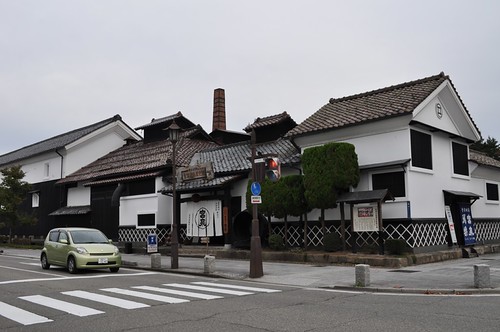
The Sake Brewery
And finally, after 3 days of travelling, we caught the Shinkansen back to Tokyo, and back to normal.
Photos can be found on flickr, as always~
Comments : Leave a Comment »
Tags: aizu wakamatsu, Food, niigata, travel, yahiko
Categories : general, travel
Yukimidaifuku
15 11 2010This is Yukimidaifuku

Basically ice cream wrapped in a thin layer of sweet mochi (white rice pounded to make a gelatinous paste)

This is Yukimidaifuku Torokeru Nama Caramel

The current seasonal flavour of Yukimidaifuku has caramel flavouring in the mochi, and a runny caramel centre!

The only words I have to express the awesome-ness of Yukimidaifuku is ‘Om nom nom’…
Comments : Leave a Comment »
Tags: Food, icecream, mochi
Categories : Food
Cosmos コスモス
12 11 2010
Pink Cosmos
There are many places with special Cosmos fields, so you can probably find something close to where you are.
This year I went to Washinomiya 鷲宮, in Saitmama 埼玉県, which is on the Tobu Isezaki Line 東部伊勢崎線, or also accessible from Higashi Washinomiya 東鷲宮 on the JR Utsunomiya line 宇都宮線. Washinomiya’s Cosmos Fureai Road コスモスふれあいロード follows a river for 12km, and is lined by over 8 million plants, so it’s makes quite a lovely Sunday afternoon stroll. They also hold a festival during the peak season (usually a weekend mid October) at the Washinomiya Town Office 鷲宮市役場.

All the pretty colours

Along the Cosmos Fureai Road

Red Cosmos Flower
To view my photos in larger sizes, please check out my Flickr set!
Comments : Leave a Comment »
Tags: cosmos, flowers, Saitama, Washinomiya
Categories : flowers
Five photos of Oze
8 11 2010Okay, so I’m a little snap happy. When I went to Oze in October I took over 200 photos… Which was then narrowed down to the 87 you can see in my Flickr set. And now I’ve chosen my 5 favourites I’d like to share with you.

Firstly, most of the hike is walking through landscape like this. Unfortunately the sun didn’t like me very much on that day, and I wasn’t really able to capture the true colour of the marshlands. It was a much more vibrant orange, which you’ll see in a later photo.

However the partially cloudy conditions meant the reflections in the ponds spotted here and there were quite pretty.

And the Autumn colours were just gorgeous!

And although it was a little wet too, it didn’t take away from the scenery.

Lastly, this photo taken at Oze Lake gives you a better idea of the colour of the marsh grasses. Just beautiful. Autumn is rapidly becoming my favourite season, but next spring don’t be surprised if I start waxing lyrical about the Cherry Blossoms!
Please click on the photos to view larger versions, or check out all my photos on Flickr!
Comments : Leave a Comment »
Tags: autumn, hiking, oze
Categories : Hikes, travel
How to become a ‘Cartoon Hero’
29 10 2010
Remember Ayers Rock? And Kanga-kun (the inflatable kangaroo?)
Well, the library at my school made a display for Australia just recently, and wanted to use the Ayers Rock and the Kangaroo, so of course I said yes. As advertising they drew a little cartoon in their newsletter to let the students know –
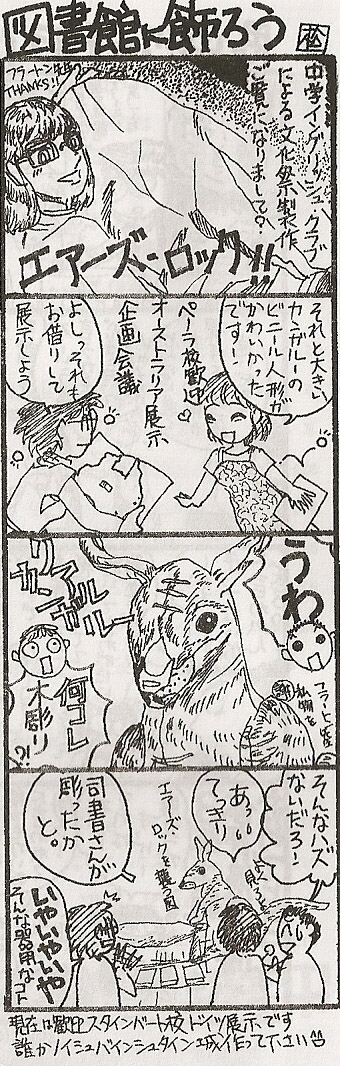
That top panel? Apparently that’s me. I always wanted to know what I’d look like as an anime character… And it’s amazing they predicted me getting a fringe!
Basically the cartoon reads as –
- *AYERS ROCK!!* Did you see the Ayers Rock that the Junior High English Club made for Culture Festival?
- The Librarians meet to plan the display about Australia… “Did you see the inflatable Kangaroo??? It was cute!” “Right, lets borrow it for our display too”
- *REAL KANGAROO* ‘Waaahh!’ “What is it?? Wood?!”
- “No way!” Looking very closely (it is kinda a wood colour…). ‘Miss Librarian, it’s wood isn’t it?’ “No, no no! It’s not made of wood…”
Comments : Leave a Comment »
Tags: anime, Australia, work
Categories : general
Hike – Mt Hiwada 日和田山
22 10 2010Quick Overview

Spider Lilies
The trail to Mt Hiwada 日和田山 is very versatile, and can be used as a starting point to hike further into Chichibu 秩父, or as an easy walk back to Hanno Station 飯能駅 as described here. If you are able to do the hike in late September, Kinchakuda 巾着田 has spectacular Spider Lilies before you head towards Koma Pass 高麗峠. With plenty of shops and bathrooms in the area, and only a 300m high peak, this hike is perfect for families, or people wanting to have a stroll through nature.
Distance: 11km
Duration: 3 and a half hours
Difficulty: easy (very very!)
Season: Suitable all year, maybe a little snow in winter months
Starting point: Koma Station 高麗駅
Finishing point: Hanno Station 飯能駅
Maps
A full map of the hike can also be viewed at GPSies
There are a lot of different and interesting hikes in the Chichibu 秩父 area, so I recommend you buy a map, particularly if you are just using Mt Hiwada 日和田山 as a starting point. The Mapple 山と高原地図 series number 22 map is of the Oku-Musahino 奥武蔵 and Chichibu 秩父 region, and is available on Amazon.co.jp. Note, this map is in Japanese, but does include some English and furigana.
The Hike

Trail Marker for Mt Hiwada
From Koma Station 高麗駅 exit, turn right and follow the road under the train lines to the intersection. Cross the road and keep going in approximately the same direction from the station down a small residential street. You will cross another road before the street turns to the left. Keep following this road until you reach a main road, and turn right. Cross the river and take the street up to the left at the next set of traffic lights. If you need to pick up some supplies there is a 7-11 a little further down the main road.
Follow the road up to the left until you see the trail marker for Mt Hiwada 日和田山 (the 3rd street on the left). Head up this street and where the street curves to the right you’ll see the trail heads for Mt Hiwada 日和田山. There is also a rest area and bath rooms here. It should only take about 15 minutes to reach this point.
While there are a few different trails you can start on, the main trail is on the right, and its the widest and most well-defined path. Follow the trail up for about 10 minutes until you reach a stone Torii gate. Here the path splits into two trails, with the trail on the left being rocky and difficult (take caution if you use this trail), and the trail on the right being easy.
Continue up on the easy path for about 15 minutes and you will reach Kotahira Shrine 金刀比羅神社. The Shrine is a good view-point, from which you can see views of Oku Chichibu 奥秩父, Oku Tama 奥多摩, and even Mt Fuji 富士山 on a good day. To reach the summit, follow the trail on the right of the shrine, it should only take about 5 minutes to reach the top.

Looking at the view from Kotahira Shrine
From the summit you can continue on towards Mt Takasasu 高指山, Mt Monomi 物見山 and Musashi Yokote Station 武蔵横手駅, if you want to do more hiking in the mountains. Although in Japanese, this Seibu Website has more information about the hike to Mt Takasasu 高指山, and a map. Otherwise, retrace your steps back down Mt Hiwada 日和田山 to the main road. It should only take about 30 minutes to return.
Once you reach the road, take the first road to the left (before crossing the bridge) and follow the river around to reach Kinchakuda 巾着田, a flower garden within a circular part of Koma River 高麗川. During late September and early October the Spider Lilies should be in bloom, and there will be plenty of people about.

Aiai Bridge
Entrance to Kinchakuda 巾着田 is 200 yen, and it will take about 40 minutes to walk from the entrance to the wooden Aiai Bridge あいあい橋 on the other side of the circle and then back to the concrete Do-Re-Me-Fa Bridge ドレミファ橋 in the middle of the circle. Once you have strolled amongst the flowers, cross the Do-Re-Me-Fa Bridge ドレミファ橋 to exit Kinchakuda 巾着田 and start on the trail to Koma Pass 高麗峠 and Hanno station 飯能駅.
Follow the path up to the left until you reach a road. Here there’s a marker pointing out the Musashino Nature Walking trail 武蔵野自然遊歩道 to Koma Pass 高麗峠. Turn right, and the road will soon become trail again. It should only take about 20 minutes to reach Koma Pass 高麗峠, where the trail splits. If you head to the left the trail will take you round past Miyazawa Lake 宮沢湖 before going back to the Nakayama Nishi 中山西 Intersection, while the trail to the right heads straight to the same intersection. It will only take about 20 minutes to come to the road if you use the direct trail.

Do-Re-Mi-Fa Bridge
One you leave the forest, cross the road at the Nakayama Nishi 中山西 intersection, and follow the road straight ahead. As it curves to the left, there is another trail on the right, up a hill there towards Mt Tenran 天覧山 and Nonin Temple 能仁寺. If you want to skip the temple keep to the road, and turn left at the second traffic lights. Just follow the road sign pointing to Higashi Hanno Station 飯能駅. Three traffic lights later turn right to go to Hanno Station 飯能駅 (again, there is a road sign pointing the way to the station). At the end of the road you’ll come to Hanno Station 飯能駅. It should take about 30 minutes from the turn off to Mt Tenran 天覧山 and Nonin Temple 能仁寺.
To and From
As always, the following routes are just recommendations. Please use Hyperdia or Jorudan’s Train Route Finder to find the most suitable route for you!
From Seibu Ikebukuro Station 西武池袋駅 take the Seibu Ikebukuro line 西武池袋線 Rapid Express 快急 or Express 急行 bound for either Hanno 飯能 or Seibu Chichibu 西武秩父, if you catch a train bound for Hanno 飯能, you will need to transfer to a local train bound for Seibu Chichibu 西武秩父 at Hanno 飯能. Get off the train at Koma Station 高麗駅, which is approximately 60 minutes and 510 yen from Ikebukuro 池袋. The Seibu line also runs a Limited Express 特急 which will take you to Hanno station 飯能駅 in approximately 50 minutes, for an extra 410 yen. If you catch the catch the Limited Express 特急 remember to change to a local train bound for Seibu Chichibu 西武秩父 at Hanno Station 飯能駅.
The return fare from Hanno Station 飯能駅 to Ikebukuro 池袋 is 450 yen, and takes 50 minutes on the Express 急行.
Links
Kinchakuda (Japanese) http://www.kinchakuda.com/
An alternate course to Musashi Yokote Station (in Japanese) http://www.hikingmap.jp/course/hiwadasan01.html and map http://www.hikingmap.jp/pdf/course_hiw.pdf
My Flickr photo set from Mt Hiwada http://www.flickr.com/photos/michelelisa/sets/72157624974213737/with/5053114941/
Map of hike on GPSies http://www.gpsies.com/map.do?fileId=huvzccgduxzseifd
Useful Kanji
Aiai Bridge あいあい橋
Chichibu 秩父
Do-Re-Me-Fa Bridge ドレミファ橋
Express 急行
Hanno Station 飯能駅
Kinchakuda 巾着田
Koma Pass 高麗峠
Koma River 高麗川
Koma Station 高麗駅
Kotahira Shrine 金刀比羅神社
Ikebukuro 池袋
Miyazawa Lake 宮沢湖
Mt Fuji 富士山
Mt Hiwada 日和田山
Mt Monomi 物見山
Mt Takasasu 高指山
Mt Tenran 天覧山
Musashino Shizen Walking trail 武蔵野自然遊歩道
Musashi Yokote Station 武蔵横手駅
Nakayama Nishi 中山西
Nonin Temple 能仁寺
Oku Chichibu 奥秩父
Oku-Musahino 奥武蔵
Oku Tama 奥多摩
Rapid Express 快急
Seibu Ikebukuro line 西武池袋線
Seibu Ikebukuro Station 西武池袋駅
Seibu Chichibu 西武秩父
Limited Express 特急
Comments : 2 Comments »
Tags: flowers, Food, mt hiwada, spider lilies
Categories : flowers, Hikes
Six Months (and not counting)
18 10 2010Well, it’s official. I’m moving back to Australia sometime next year. I’ve decided not to sign a new contract, so from April I’ll be a free agent. I can’t tell you how much I look forward to not teaching (the little sh*ts).
Actually, my job is still pretty good, and the holidays are still brilliant, but it’s time to move back to the ‘real world’ and get a career. I never wanted to be an English teacher for the rest of my life, and so, I need to start trying for what I want.
Living in Japan for a long period of time has been great. I came (this time) with 3 goals in mind – travel as much of the country as I can, climb Mt Fuji, and pass the Japanese Language Proficiency Test Level 2. I’m pretty happy to say I’ve achieved the first two, and I’m going to make my final attempt of Level 2 in December.
But there are still things I have yet to do. Like go to Ueno Zoo, or Shikoku even… So I made a list (If you haven’t noticed, I like to list things). My 6 month list has a lot on it already, so I won’t bore you with the details, but most things I’ll post about over the next 5 months or so will be things from the list.
For example, the other week I went to the Edo-Tokyo Open Air Architectural Museum. I’ve been meaning to go there for years, and I just lucked out in that on the day I went it was free admission.
The museum is in Kogane park, and contains a number of buildings from Tokyo over the last 200 years or so. In particular, I wanted to go because some of the buildings were used as inspiration for the Studio Ghibli movie Spirited Away. Like the Public Bathhouse –

And the Stationary Store –

But the thing that really struck me was how much I’m going to miss the little details when I leave Japan, like shaped windows and rice paper –

bamboo –

lattice work –

carvings –


and of course gardens –

Although it wasn’t the best examples I’ve seen, the museum was a pleasant day out. And just enough to satisfy my taste for the Japanese aesthetic. Check out my other photos on flickr!
Comments : Leave a Comment »
Tags: buildings, gardens, open air museum, tokyo, travel
Categories : general, travel
Golden Oze
15 10 2010Well, even though I have no way of uploading this at the moment of typing, I feel I just have to write down my feelings.
See, right now, at 4:43pm Thursday, I’m sitting in my own room in a mountain hut at the northern end of Oze marsh.
And I am starving, despite having a late lunch at 1. Luckily dinner is at 5:30. And then lights out at 8:30. It feels kinda novel in a way to have no phone reception and plans to go to bed so early, but I’m in a beautiful part of japan, and it also kinda fits.
Oze is just beautiful. I love autumn colors to start with, so that doesn’t hurt, but when I look at the hills around me it’s like a glorious natural patchwork quilt.
And the marsh itself was literally glowing golden in the afternoon sun. Even the boardwalk seemed to complement the setting.
It’s been surprisingly easy to get here and get around. I had worked myself up a bit about the whole having to catch a bus and not having a reservation at this mountain hut. But it all worked out perfectly. I had no reason at all to worry. I just hope tomorrow goes as smoothly.
But I’m sure, just being around this glorious natural beauty will be enough to take away my stresses.
Not looking forward to going back to Tokyo tomorrow night *sigh*

Comments : 2 Comments »
Tags: autumn, hiking, oze
Categories : Hikes, travel
Kinchakuda Manjushage 巾着田の曼珠沙華
9 10 2010
Manjushage
Manjushage 曼珠沙華, or Spider Lilies, bloom in late September to early October. They can be spotted in small numbers in gardens and green areas around Tokyo, and are quite beautiful, but are spectacular en masse.
Kinchakuda 巾着田 is about one hour out from Ikebukuro on the Seibu Ikebukuro line and the Seibu Chichibu line, and is accessible from Koma Station 高麗駅. It is a flower field on the inside of a river that almost curves around 360 degrees, and has over a million blooms in red and a few in white. It also has a small field of Cosmos コスモス that bloom around the same time, and a number of hikes and walks in the area. Entrance to the park is 200yen. More details about Kinchakuda 巾着田 can be found on the official website (Japanese only).
A guide to hiking the nearby Mt Hiwata and Koma Pass is also coming soon.
Here are a few photos from my visit to the field on October 2nd 2010.

White Manjushage

Kinchakuda

Manjushage and Koma River

Red Manjushage
For more photos of Manjushage check out my set at Flickr!
Comments : Leave a Comment »
Tags: flowers, manjushage, Saitama, spider lily
Categories : flowers
 the story of an Aussie girl living in Japan, who loves travel, hiking, walking, flowers and food.


 yamaonna